
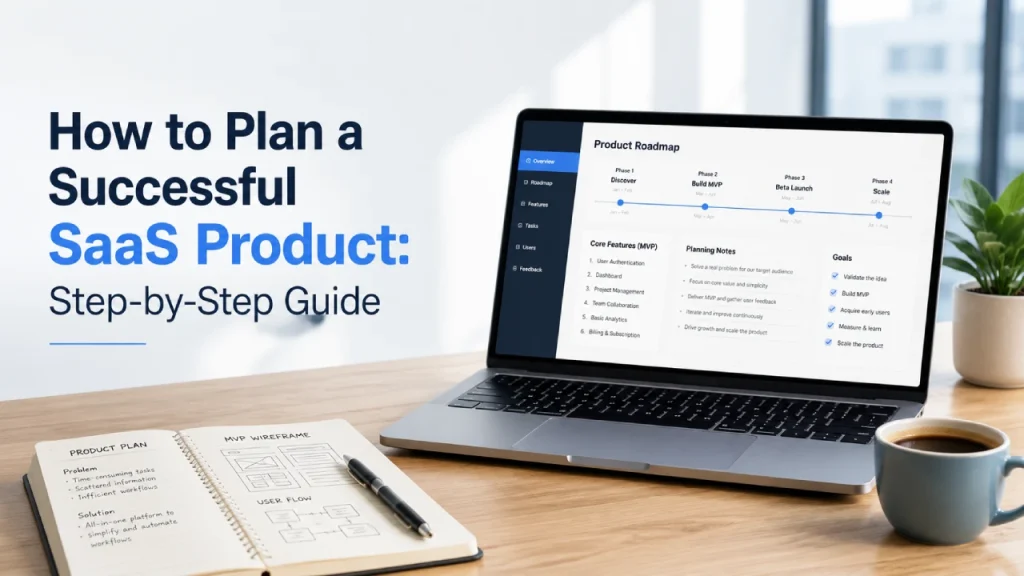
How to Plan a Successful SaaS Product: Step-by-Step Guide
Launching a Software as a Service (SaaS) product can be incredibly rewarding, but success rarely happens by chance. Behind every popular SaaS platform is a well-thought-out plan that aligns customer needs, business goals, and technical execution. Whether you’re building a project management tool, CRM, HR platform, or AI-powered application, planning is the stage that determines whether your product will gain traction or struggle to find users.
Many entrepreneurs make the mistake of jumping straight into development because they have a great idea. However, writing code without validating the concept, understanding the market, or defining a clear roadmap often leads to wasted time, budget overruns, and products that fail to solve real problems.
According to industry reports, a significant percentage of startups fail because there is little or no market demand for their product. This highlights an important truth: successful SaaS products are planned before they are built.
In this guide, you’ll learn how to plan a successful SaaS product step by step. From identifying a market problem and validating your idea to creating an MVP and preparing for launch, we’ll cover the essential stages that lay the foundation for long-term growth.
What Is SaaS Product Planning?
SaaS product planning is the strategic process of defining what your software will do, who it will serve, and how it will achieve business goals before development begins. It combines market research, customer insights, product strategy, feature prioritization, pricing considerations, and technical planning into one structured roadmap.
Think of SaaS product planning as creating the blueprint for a house. You wouldn’t start construction without knowing the design, materials, budget, or purpose of the building. Similarly, a SaaS product needs a clear direction before developers begin writing code.
A comprehensive SaaS product plan typically answers questions such as:
- What problem does the product solve?
- Who are the target customers?
- What features should be included in the first release?
- How will the product generate revenue?
- What technologies will support future growth?
- How will success be measured after launch?
Answering these questions early helps reduce uncertainty and ensures that everyone involved—from founders and product managers to developers and marketers—is working toward the same objectives.
Why Is SaaS Product Planning Important?
Planning is more than a preliminary step; it’s a strategic investment that influences every stage of your product’s lifecycle. A strong plan helps teams make informed decisions, avoid unnecessary work, and build software that delivers real value.
Reduces Development Risks
Software development requires significant investments of time, money, and expertise. Without proper planning, teams may build features that customers don’t need or overlook essential functionality.
By researching the market and validating ideas before development begins, businesses can reduce uncertainty and focus resources on solving genuine customer problems.
Saves Time and Budget
Every unnecessary feature, design revision, or architectural change increases development costs.
Planning allows teams to:
- Define clear priorities
- Allocate resources efficiently
- Prevent scope creep
- Minimize expensive rework
Instead of constantly changing direction during development, a well-planned project follows a structured roadmap that keeps everyone aligned.
Aligns the Product with Customer Needs
The best SaaS products don’t succeed because they have the most features—they succeed because they solve meaningful problems.
Product planning encourages businesses to understand:
- Customer pain points
- Daily workflows
- Buying behavior
- User expectations
These insights help create solutions that customers actually want to use and pay for.
Creates a Clear Development Roadmap
A roadmap acts as the project’s navigation system.
It defines:
- Development phases
- Feature priorities
- Release timelines
- Team responsibilities
- Business objectives
Without a roadmap, development can become reactive instead of strategic, making it difficult to manage deadlines or maintain product quality.
Improves Long-Term Scalability
Many SaaS startups focus only on launching quickly, overlooking how the product will evolve as user demand grows.
Planning ahead helps businesses prepare for:
- Larger customer bases
- Increased data storage
- Additional integrations
- New feature releases
- Performance optimization
Scalable planning reduces the need for major architectural changes later, saving both time and resources.
Step 1: Identify a Real Problem to Solve
Every successful SaaS product begins with a problem worth solving—not just an interesting idea.
Customers don’t purchase software because it’s innovative; they purchase it because it makes their work easier, faster, or more efficient.
Instead of asking, “What kind of software should I build?”, ask:
“What problem do people struggle with every day?”
The stronger and more urgent the problem, the more valuable your solution becomes.
Understand Your Target Market
Before defining features, identify who your ideal users are.
Ask questions like:
- Which industry are they in?
- What is the size of their business?
- What tools are they currently using?
- What challenges do they face regularly?
- How much are they willing to invest in a solution?
A deep understanding of your target market helps you build a product that addresses real-world needs rather than assumptions.
Identify Customer Pain Points
Pain points are the frustrations, inefficiencies, or obstacles users encounter while completing tasks.
Some common SaaS pain points include:
- Repetitive manual work
- Poor collaboration
- Slow reporting
- Disconnected software tools
- Data management challenges
- Inefficient workflows
The more specific the problem, the easier it becomes to design a valuable solution.
For example, instead of creating “another project management app,” you might focus on helping remote marketing teams automate campaign approvals.
Define Your Ideal Customer Persona
A customer persona is a detailed representation of your ideal user based on research and data.
Include factors such as:
- Job title
- Industry
- Company size
- Goals
- Daily responsibilities
- Challenges
- Preferred software
- Budget expectations
Creating personas helps ensure that product decisions remain focused on real users instead of broad assumptions.
Step 2: Validate Your SaaS Product Idea
A great idea isn’t enough—you need evidence that people are willing to use and pay for your product.
Idea validation helps determine whether your concept has genuine market demand before significant development costs are incurred.
Conduct Market Research
Research your industry to understand:
- Market trends
- Growth opportunities
- Customer expectations
- Emerging technologies
- Competitive landscape
Reliable market research reveals opportunities where existing solutions may be falling short.
Analyze Competitors
Competitor analysis isn’t about copying others—it’s about identifying opportunities to do something better.
Study competing SaaS products and evaluate:
- Core features
- Pricing models
- User reviews
- Strengths
- Weaknesses
- Customer complaints
Negative reviews are particularly valuable because they highlight gaps your product can address.
Gather Feedback from Potential Users
Talk directly with your target audience before writing code.
Useful methods include:
- One-on-one interviews
- Online surveys
- Community forums
- LinkedIn outreach
- Industry groups
- Beta sign-up forms
Ask open-ended questions such as:
- What is your biggest challenge?
- How do you currently solve it?
- What frustrates you about existing tools?
- Which features would provide the most value?
Real conversations often reveal insights that market reports cannot.
Test Demand Before Development
Before investing months in development, confirm that people are genuinely interested.
You can validate demand by:
- Creating a landing page
- Running small advertising campaigns
- Collecting email sign-ups
- Offering early access
- Building clickable prototypes
- Launching a waitlist
If users are willing to share their contact information—or even pre-order your solution—that’s a strong indicator of market interest.
Step 3: Define Your Value Proposition
Once you’ve validated your idea, the next step is defining why customers should choose your product over existing alternatives.
Your Unique Value Proposition (UVP) is a concise statement that communicates the primary benefit your SaaS product delivers and what makes it different from competitors.
A strong value proposition answers three questions:
- What problem do you solve?
- Who do you solve it for?
- Why is your solution better than the alternatives?
For example, instead of saying:
“We offer project management software.”
A stronger value proposition would be:
“We help remote marketing teams manage campaigns, automate approvals, and collaborate in one centralized platform—without the complexity of traditional project management tools.”
This version is specific, audience-focused, and outcome-driven.
As you refine your value proposition, avoid making vague claims such as “best,” “fastest,” or “most innovative.” Instead, emphasize measurable benefits like saving time, reducing costs, improving collaboration, or simplifying workflows.
A clear value proposition also serves as the foundation for your messaging, website copy, marketing campaigns, and future product positioning.
Step 4: Set Clear Business Goals
A successful SaaS product isn’t built solely around features—it is built around measurable business objectives. Once you’ve validated your idea and defined your value proposition, the next step is to establish clear goals that guide every decision throughout development and beyond.
Without defined objectives, it becomes difficult to prioritize features, allocate resources, or evaluate whether your product is moving in the right direction.
A practical way to set goals is by following the SMART framework. Each goal should be Specific, Measurable, Achievable, Relevant, and Time-bound. For example, instead of saying, “Get more users,” set a goal like “Acquire 1,000 active users within six months of launch.”
Revenue Goals
Revenue goals help determine the financial direction of your SaaS business. These goals influence pricing, marketing budgets, customer acquisition strategies, and long-term growth plans.
Examples include:
- Achieving a target Monthly Recurring Revenue (MRR)
- Reaching profitability within a specific timeframe
- Increasing average revenue per customer
- Expanding into new market segments
Having realistic revenue targets helps ensure sustainable growth rather than focusing only on user numbers.
User Acquisition Goals
Customer growth is essential for every SaaS business. Establish clear targets for acquiring new users and identify the marketing channels that will support those goals.
You might define objectives such as:
- Gaining the first 500 paying customers
- Increasing website conversion rates
- Growing organic traffic through SEO
- Expanding referral and partnership programs
These goals create alignment between your product and marketing teams from the very beginning.
Customer Retention Goals
Acquiring customers is only part of the equation. Retaining them is what creates predictable recurring revenue.
Set goals related to:
- Customer satisfaction
- User engagement
- Product adoption
- Renewal rates
- Reducing churn
A SaaS product that retains customers consistently will usually outperform one that relies solely on acquiring new users.
Product Success Metrics
Determine how you’ll measure product performance after launch.
Common success indicators include:
- Daily Active Users (DAU)
- Monthly Active Users (MAU)
- Feature adoption rate
- Trial-to-paid conversion rate
- Customer satisfaction scores
- Net Promoter Score (NPS)
Tracking these metrics early allows you to make informed improvements as your product evolves.
Step 5: Prioritize Features and Plan Your MVP
One of the biggest mistakes SaaS founders make is trying to build everything at once. While it’s tempting to include every feature users might eventually need, this often delays launch, increases costs, and complicates the user experience.
Instead, focus on building a Minimum Viable Product (MVP)—a version of your software that delivers core value with the fewest essential features.
Launching an MVP allows you to gather real user feedback, validate assumptions, and improve your product based on actual customer needs.
List All Potential Features
Start by brainstorming every feature your product could include.
Examples might be:
- User authentication
- Dashboard
- Notifications
- Analytics
- Reporting
- Team collaboration
- API integrations
- Mobile support
- Payment processing
At this stage, don’t worry about prioritization—simply capture every idea.
Separate Essential and Nice-to-Have Features
Once you’ve listed all potential features, categorize them based on importance.
Ask yourself:
- Does this feature solve the core problem?
- Can users achieve their primary goal without it?
- Will delaying this feature impact the product launch?
A useful framework is the MoSCoW Method, which divides features into:
- Must Have – Essential for launch
- Should Have – Important but not critical
- Could Have – Valuable if time and budget allow
- Won’t Have (for now) – Future enhancements
This structured approach keeps development focused on delivering immediate value.
Build a Minimum Viable Product (MVP)
Your MVP should solve one primary problem exceptionally well instead of solving many problems poorly. Before moving into development, it’s also important to understand the custom SaaS development process so you can make informed decisions about architecture, scalability, and feature implementation from the start.
For example, if you’re building a CRM platform, your MVP might include:
- User registration
- Contact management
- Sales pipeline
- Basic reporting
Advanced features such as AI recommendations, workflow automation, or third-party integrations can be introduced in later updates.
Launching early provides valuable insights that no amount of internal testing can replace.
Avoid Feature Creep
Feature creep occurs when additional functionality is continuously added during development.
This often leads to:
- Missed deadlines
- Increased costs
- Complicated user interfaces
- Higher maintenance requirements
Every new feature should support your product vision and address a validated customer need.
If it doesn’t, consider saving it for a future release.
Step 6: Create a SaaS Product Roadmap
A product roadmap is a strategic plan that outlines how your SaaS product will evolve over time. It provides direction for your development team while keeping stakeholders informed about priorities and timelines.
Rather than treating your roadmap as a rigid schedule, think of it as a living document that adapts based on user feedback and market changes.
Define Development Milestones
Break your project into manageable phases.
For example:
- Product discovery
- UI/UX design
- MVP development
- Internal testing
- Beta release
- Public launch
- Feature expansion
Each milestone should have clear objectives and measurable outcomes.
Set Realistic Timelines
One of the most common reasons software projects fail is unrealistic scheduling.
Instead of rushing development, estimate timelines based on:
- Team capacity
- Technical complexity
- Testing requirements
- Third-party integrations
- Potential risks
Building flexibility into your schedule helps accommodate unexpected challenges without sacrificing quality.
Plan for Future Feature Releases
Successful SaaS products improve continuously after launch.
Your roadmap should include:
- Quarterly feature updates
- Performance improvements
- Customer-requested enhancements
- Security updates
- Scalability improvements
Planning beyond version one ensures your product remains competitive.
Choose an Agile Development Approach
Most SaaS teams use Agile methodologies because they encourage continuous improvement and rapid iteration.
Benefits of Agile include:
- Faster feedback cycles
- Better collaboration
- Frequent product improvements
- Greater flexibility
- Reduced development risk
Short development sprints allow teams to deliver value incrementally rather than waiting months for a major release.
Step 7: Choose the Right Technology Stack
The technology stack you choose will affect your product’s performance, scalability, security, and maintenance costs.
Rather than selecting technologies based on popularity, choose tools that align with your product requirements and long-term goals.
If your business lacks in-house expertise, partnering with an experienced custom software development team can help you evaluate technology options, design scalable architecture, and avoid costly technical decisions during the planning phase.
Frontend Technologies
The frontend determines how users interact with your application.
Popular options include:
- React
- Angular
- Vue.js
- Next.js
Choose a framework that supports responsive design, fast performance, and long-term maintainability.
Backend Technologies
Your backend manages business logic, APIs, authentication, and data processing.
Common technologies include:
- Node.js
- Python
- Java
- .NET
- PHP
- Go
The right choice depends on your team’s expertise and application requirements.
Database Selection
Your database should support both current needs and future growth.
Popular options include:
- PostgreSQL
- MySQL
- MongoDB
- Microsoft SQL Server
Consider factors such as performance, scalability, security, and reporting capabilities.
Cloud Infrastructure
Cloud platforms simplify deployment while providing scalability and reliability.
Popular providers include:
- Amazon Web Services (AWS)
- Microsoft Azure
- Google Cloud Platform (GCP)
Cloud infrastructure allows businesses to expand resources as user demand increases.
Security and Compliance
Security should never be treated as an afterthought.
Plan for:
- Data encryption
- Secure authentication
- Role-based access control
- Backup and disaster recovery
- Regulatory compliance (GDPR, HIPAA, SOC 2, etc., where applicable)
Strong security builds customer trust and protects sensitive information.
Scalability Considerations
As your user base grows, your infrastructure should scale without requiring major redesigns.
Consider:
- Load balancing
- Microservices (if appropriate)
- Containerization
- Auto-scaling
- Performance monitoring
- API scalability
Planning for growth early reduces technical debt later.
Step 8: Design a User-Centric Experience
Even the most powerful SaaS product can fail if users find it confusing or difficult to navigate.
An intuitive user experience (UX) increases customer satisfaction, reduces support requests, and improves retention.
Good design isn’t just about aesthetics—it’s about helping users accomplish their goals quickly and efficiently.
Map the User Journey
Understand every step users take from signing up to achieving their desired outcome.
Ask questions like:
- How do users discover the product?
- What happens after registration?
- Which actions help users experience value quickly?
- Where might users encounter friction?
Mapping the journey helps identify opportunities to simplify workflows.
Create Wireframes and Prototypes
Before development begins, visualize your product using wireframes and interactive prototypes.
These designs allow stakeholders and potential users to provide feedback before resources are invested in coding.
Early validation often prevents costly redesigns later.
Focus on Simple and Intuitive UI/UX
Avoid overwhelming users with unnecessary complexity.
Prioritize:
- Clear navigation
- Consistent layouts
- Readable typography
- Logical workflows
- Fast-loading interfaces
Every screen should have a clear purpose and guide users toward completing important tasks.
Optimize for Mobile and Accessibility
Modern users expect software to work seamlessly across devices.
Ensure your product:
- Adapts to different screen sizes
- Loads quickly on mobile networks
- Supports keyboard navigation
- Provides sufficient color contrast
- Includes descriptive labels for assistive technologies
Accessible design benefits all users while expanding your potential audience.
By completing these eight planning stages, you’ve established a strong foundation for your SaaS product. However, even the best-designed software won’t succeed without the right pricing, launch strategy, and ongoing performance measurement.
Step 9: Plan Your SaaS Pricing Strategy
Your pricing strategy is one of the most important business decisions you’ll make. Price your product too high, and you may struggle to attract customers. Price it too low, and you risk undervaluing your product while limiting your ability to grow.
A successful SaaS pricing strategy balances customer expectations, perceived value, operating costs, and business goals. Instead of copying competitors, focus on the value your product delivers and how it solves your customers’ problems.
Remember that pricing isn’t permanent. As your product evolves, gains new features, and builds credibility, you can refine your pricing based on customer feedback and market demand.
Subscription-Based Pricing
Subscription pricing is the most common model for SaaS businesses. Customers pay a recurring monthly or annual fee to access the software.
This model provides predictable revenue while allowing businesses to continuously improve their products.
Examples include:
- Basic Plan
- Professional Plan
- Enterprise Plan
Each tier should provide additional value rather than simply restricting features.
Freemium Model
The freemium model allows users to access a limited version of your product at no cost.
The goal is to let users experience the software before upgrading to premium features.
A successful freemium strategy should:
- Deliver genuine value in the free plan
- Clearly demonstrate the benefits of upgrading
- Encourage users to adopt the product regularly
Avoid making the free version so limited that users can’t understand the product’s value.
Free Trial Strategy
A free trial gives users full or partial access to premium features for a limited time.
To maximize conversions:
- Simplify the signup process
- Provide onboarding guidance
- Highlight key features quickly
- Offer helpful support during the trial
- Send reminder emails before the trial expires
The faster users experience value, the more likely they are to become paying customers.
Usage-Based Pricing
Some SaaS products charge customers based on how much they use the service.
Examples include pricing based on:
- API requests
- Storage usage
- Number of users
- Transactions processed
- Emails sent
Usage-based pricing works well for businesses with highly variable customer needs.
Factors to Consider Before Finalizing Pricing
Before launching your pricing model, evaluate:
- Target audience budget
- Competitor pricing
- Cost of customer acquisition
- Infrastructure expenses
- Customer lifetime value
- Expected profit margins
Regularly review pricing performance as your business grows and customer expectations evolve.
Step 10: Develop a Go-to-Market Strategy
Even an outstanding SaaS product can fail if people don’t know it exists.
A Go-to-Market (GTM) strategy outlines how you’ll introduce your product to your target audience, attract customers, and generate sustainable growth.
Rather than treating marketing as an afterthought, build it into your product planning process from the beginning.
Build Your Brand Identity
Your brand should clearly communicate:
- Who you serve
- What problems you solve
- What makes your product different
- Why customers should trust you
Consistency across your website, product interface, social media, and marketing materials helps build recognition and credibility.
Prepare Your Marketing Channels
Identify where your ideal customers spend their time.
Common acquisition channels include:
- Organic search (SEO)
- Social media
- Email marketing
- Paid advertising
- Industry communities
- Partnerships
- Referral programs
You don’t need to be active everywhere. Focus on the channels most likely to reach your target audience effectively.
Create a Content Marketing Plan
Content marketing builds authority while attracting potential customers throughout their buying journey.
Consider creating:
- Educational blog posts
- Case studies
- Product tutorials
- Comparison articles
- Videos
- Webinars
- Downloadable guides
Consistently publishing valuable content positions your company as a trusted resource rather than simply another software vendor.
Optimize Your Website for SEO
Your website is often the first impression potential customers have of your business.
To improve organic visibility:
- Target relevant keywords
- Publish helpful content
- Improve page speed
- Optimize metadata
- Build internal links
- Create landing pages for core features
- Earn quality backlinks
SEO is a long-term investment that can generate consistent traffic without relying entirely on paid advertising.
As your product gains traction, combining SEO with professional digital marketing services can help expand your reach, improve lead generation, and support sustainable customer acquisition across multiple channels.
Plan Your Product Launch
A successful launch requires preparation well before release day.
Your launch checklist might include:
- Beta testing
- Press outreach
- Email campaigns
- Product Hunt submission
- Social media announcements
- Customer onboarding materials
- Demo videos
- Knowledge base documentation
A coordinated launch creates momentum and increases early adoption.
Step 11: Measure Success with Key SaaS Metrics
Launching your SaaS product is only the beginning. Measuring performance helps you understand what’s working, identify opportunities for improvement, and make informed business decisions.
Rather than tracking dozens of metrics, focus on the KPIs that directly impact growth and profitability.
Monthly Recurring Revenue (MRR)
MRR represents the predictable monthly revenue generated from subscriptions.
It is one of the most important metrics for evaluating business growth and forecasting future revenue.
Customer Acquisition Cost (CAC)
CAC measures how much it costs to acquire a new customer.
It includes expenses such as:
- Advertising
- Sales
- Marketing software
- Content creation
- Campaign management
Keeping acquisition costs under control is essential for profitability.
Customer Lifetime Value (CLV)
Customer Lifetime Value estimates the total revenue a customer is expected to generate throughout their relationship with your business.
A healthy SaaS business typically has a CLV that significantly exceeds its CAC.
Churn Rate
Churn measures the percentage of customers who cancel their subscriptions during a specific period.
High churn often indicates issues with:
- Product quality
- User experience
- Customer support
- Pricing
- Onboarding
Reducing churn is often more cost-effective than constantly acquiring new customers.
Customer Retention Rate
Retention measures how successfully your business keeps existing customers over time.
Improving retention often leads to:
- Higher recurring revenue
- Greater customer loyalty
- Lower acquisition costs
- Stronger brand reputation
Activation Rate
Activation measures how many users complete the key actions that demonstrate they’ve experienced your product’s value.
For example:
- Creating a first project
- Inviting teammates
- Uploading data
- Completing onboarding
Improving activation often increases long-term customer retention.
Common Mistakes to Avoid When Planning a SaaS Product
Even experienced founders can make planning mistakes that delay growth or reduce product adoption. Recognizing these pitfalls early can save significant time, money, and effort.
Skipping Market Validation
Building software without confirming customer demand is one of the fastest ways to waste development resources.
Always validate your idea before investing heavily in development.
Building Too Many Features Too Soon
Trying to satisfy every possible customer often results in bloated software that takes longer to build and is harder to use.
Focus on solving one core problem exceptionally well before expanding your feature set.
Ignoring Customer Feedback
Customer feedback should guide your product roadmap—not personal assumptions.
Listen to users through surveys, interviews, support tickets, and analytics to continuously improve your product.
Choosing the Wrong Pricing Model
An unsuitable pricing structure can limit growth, reduce conversions, or discourage upgrades.
Regularly test and refine your pricing strategy based on customer behavior and market conditions.
Underestimating Security and Scalability
As your user base grows, security vulnerabilities and infrastructure limitations become increasingly expensive to fix.
Planning for scalability from the beginning reduces technical debt and supports long-term growth.
Launching Without a Marketing Plan
Many founders spend months building software but very little time planning how to attract users.
Marketing should begin before launch—not after it.
SaaS Product Planning Checklist
Use this checklist before moving into development:
✅ Identify a real market problem
✅ Define your target audience
✅ Create customer personas
✅ Validate your SaaS idea
✅ Research competitors
✅ Define your unique value proposition
✅ Set measurable business goals
✅ Prioritize features
✅ Build an MVP plan
✅ Create a product roadmap
✅ Choose the right technology stack
✅ Design a user-friendly experience
✅ Develop a pricing strategy
✅ Prepare a go-to-market plan
✅ Define key SaaS performance metrics
If you can confidently check every item on this list, you’ll be in a much stronger position to build a successful SaaS product.
FAQs
SaaS product planning is the process of defining your product strategy, target audience, features, pricing, technology, and roadmap before development begins. It helps reduce risk and ensures your software addresses real customer needs.
The timeline varies depending on the project's complexity. For most startups, the planning phase typically takes anywhere from a few weeks to a few months and includes research, validation, feature prioritization, and roadmap creation.
An MVP (Minimum Viable Product) includes only the essential features needed to solve a core problem and gather user feedback. A full SaaS product contains additional functionality, refinements, and integrations developed over multiple iterations.
You can validate a SaaS idea by conducting market research, analyzing competitors, interviewing potential customers, launching a landing page, collecting waitlist signups, or releasing an MVP to a small group of users.
A SaaS roadmap should outline development phases, feature priorities, milestones, timelines, resource allocation, and future improvements while remaining flexible enough to adapt to user feedback and changing market conditions.
Conclusion
Planning is the foundation of every successful SaaS product. While it’s tempting to move directly into development, taking the time to research your market, validate your idea, define a clear value proposition, prioritize features, and create a strategic roadmap can significantly improve your chances of long-term success.
Remember that launching a SaaS product is not a one-time event—it’s an ongoing process of learning, improving, and adapting to customer needs. Start with a focused MVP, gather feedback from real users, monitor key performance metrics, and continue refining your product through iterative development.
Whether you’re building your first SaaS application or expanding an existing software business, a thoughtful planning process will help you minimize risk, make smarter decisions, and deliver lasting value to your customers.
If you’re ready to turn your SaaS idea into a scalable, high-performing solution, working with an experienced custom software development team can help you move from strategy to execution with confidence. And once your product is ready to launch, combining it with a well-planned digital growth strategy and effective digital marketing services can help you reach the right audience, generate qualified leads, and support long-term business growth.


