
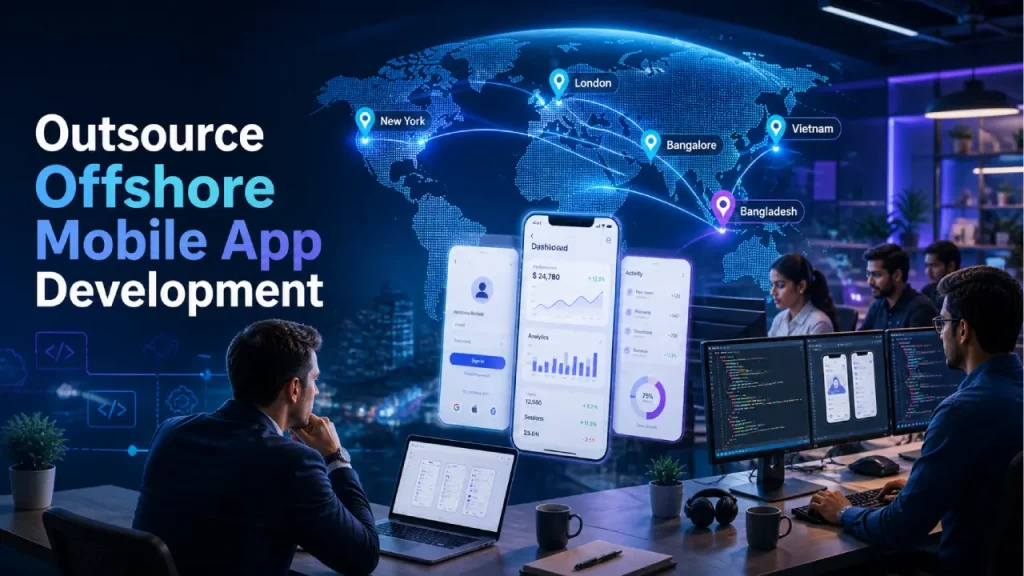
Outsource Offshore Mobile App Development: A Complete Guide
Offshore mobile app development is more than just reduced cost. It includes meticulous decision-making, handling different people, and running a remote team efficiently.
Working with an offshore team changes your requirements management process, communication, and delivery timeline setting. Without the right setup, even a strong team can struggle to align with your expectations. This is exactly why you need a proper guide to make things right.
This guide walks through offshore development from a practical view, covering models, workflows, costs, and the decisions that actually impact delivery and product quality.
Understanding Offshore Mobile App Development
Before getting into models, costs, or vendors, let’s understand what offshore development actually involves in practice. In simple words, it’s a different way of structuring your team, communication, and delivery process.
What is Offshore Mobile App Development?
Offshore mobile app development means outsourcing your app design, development, and maintenance to a team located in a distant country, typically in a different time zone.
It’s not just “outsourcing to another country.” It’s a different way of structuring your team, communication, and the delivery process. In most cases, companies in regions like the US, UK, or Western Europe work with teams in countries such as India, Bangladesh, Vietnam, or Eastern Europe. The primary drivers of this model are cost efficiency and access to skilled developers. But it also means companies need to adopt a new working model.
Typically, an offshore setup includes:
- A remote development team (developers, QA, sometimes designers)
- A project manager or point of contact
- Communication through tools like Slack, Jira, or email
- Regular syncs (daily/weekly depending on workflow)
The key difference from local development is that you’re not just entrusting tasks, you’re coordinating across different distances, time zones, and often cultural working styles.
Onshore vs Nearshore vs Offshore: Pros and Cons
People often get confused about these models, but the distinction is simple: it’s based on location and proximity to your business. Here’s the difference between all three of these models:
Onshore Development
Onshore means working with a team in your own country. Here, management is easier, but access to talent is limited.
Pros:
- Easier communication (same language, time zone)
- Better alignment of expectations and work culture
- Simpler legal and compliance handling
Cons:
- Higher development costs
- Limited access to niche or specialized talent in some cases
Nearshore Development
Nearshore refers to outsourcing work to a nearby country, usually within a similar or overlapping time zone.
Pros:
- Partial time zone overlap for real-time collaboration
- Lower cost than onshore, but higher than offshore
- Fewer cultural and communication gaps compared to offshore
Cons:
- Access to talent may still be limited, depending on the region
- Cost savings are moderate, not significant
Offshore Development
Offshore work involves collaborating with teams in distant countries, often with significant time zone differences.
Pros:
- Significant cost savings compared to onshore
- Access to a large global talent pool
- Ability to run development cycles across time zones (extended work hours)
Cons:
- Communication delays if not managed well
- Time zone differences can slow feedbacks
- Requires structured processes to maintain quality and alignment
Why Businesses Choose Offshore Development
Companies don’t choose offshore development for just one single reason; usually, it’s a combination of cost, access, and flexibility. But you can reap these benefits only if the project is managed correctly. However, here are the most popular reasons businesses choose offshore development:
Cost Efficiency and ROI
Differences in labor costs across regions play the biggest role in offshore development decisions. For example, hourly development rates in South Asia or Eastern Europe are often significantly lower than in North America or Western Europe.
However, lower cost doesn’t automatically mean higher ROI. Real savings come when:
- Requirements are clearly defined
- Rework is minimized
- Communication is consistent
Otherwise, delays and revisions can offset the initial cost advantage. So be careful with your approach to get the best out of the offshore work.
Access to Global Talent and Niche Expertise
Offshore development opens access to specialized skills that may not be available locally, especially in areas like:
- Cross-platform development (Flutter, React Native)
- Backend scalability (Node.js, microservices)
- AI/ML integrations
This is super useful for startups or companies building technically complex apps without hiring full in-house teams. It helps with cost-cutting and having a team of global talent.
Faster Time-to-Market
With the right setup, offshore teams can help speed up development cycles. Some companies use time zone differences strategically. The work continues while the in-house team is offline.
This approach works best only when:
- Tasks are clearly defined
- Handoffs between teams are structured
- There’s minimal ambiguity in requirements
Without that, time differences can slow things down rather than speed them up. So ensure both teams collaborate. Set off at a middle ground and keep themselves up to date.
Scalability and Flexibility
Offshore teams allow you to scale resources up or down without long-term hiring commitments. You can keep the work flexible without any accountability to the team you are working with.
For example:
- Add developers during peak development phases
- Reduce team size after launch
- Bring in specialists only when needed
This flexibility is harder to achieve with a fully in-house team. Whereas with offshore development, you can easily manage the team as needed.
Risk Mitigation and Business Continuity
Working with distributed teams can also reduce operational risk. If one location faces disruptions, be it technical, environmental, or logistical, you can continue working from another location. This reduces business risk without delaying your work. This type of work is especially beneficial for customer-focused businesses that cannot afford to lose seconds to attend to their customers.
With that said, this benefit depends on how well the offshore partner is structured, especially their backup systems, team redundancy, and internal processes.
Offshore Development Models Explained
The offshore model directly affects how your app is built, how communication flows, and how much control you have over the process. Most offshore engagements fall into a few standard models. Each one works well in a specific situation, but can create friction if used in the wrong context. So let’s get to know all those offshore development models so yours don’t fall short:
Project-Based Model
In the project-based model, you hand over the entire app or a defined part of it to an offshore team with clear requirements, timeline, and budget. The vendor takes responsibility for delivery.
This usually runs on a fixed-price or milestone-based contract, where the scope is agreed up front.
How it works?
- You define features, timelines, and deliverables
- The offshore team plans, develops, and delivers the project
- Progress is tracked through milestones or phases
Where it fits best:
- MVPs with clearly defined features
- Small to mid-sized apps with limited scope changes
- Projects where you don’t want to manage day-to-day development
What to watch out for:
- Limited flexibility if requirements change mid-project
- Risk of misalignment if the initial scope isn’t detailed enough
This model works well when you know exactly what you want. It becomes risky if you’re just starting the product.
Dedicated Development Team Model
In this model, you hire a full offshore team that works exclusively on your project, virtually serving as an extension of your in-house team. Instead of paying for a project, you pay for the time and resources (monthly or hourly).
How it works:
- You select developers, designers, or QA engineers
- The team works under your direction and priorities
- You manage tasks, workflows, and roadmap decisions
Where it fits best:
- Long-term projects or ongoing product development
- Startups building and iterating continuously
- Companies that want control without hiring locally
What to watch out for:
- Requires active involvement in management and planning
- Success depends on strong communication and leadership
This model offers flexibility and control, but you also need to be more engaged.
Staff Augmentation Model
Staff augmentation is about adding specific offshore developers to your existing team to fill skill gaps or to increase capacity. In this model, you’re not outsourcing the whole project; you’re expanding your team remotely.
How it works:
- You identify roles or skills you need (e.g., React Native developer)
- Offshore developers join your team and follow your processes
- Your internal team leads the project
Where it fits best:
- Companies with an existing development team
- For short-term scaling needs or tight deadlines
- Projects requiring specific technical expertise
What to watch out for:
- Requires strong internal processes and onboarding
- Integration challenges if workflows aren’t clearly defined
If your goal is to quickly extend your in-house team without long hiring cycles, a structured IT resource augmentation approach can help you scale with the right skills on demand.
Hybrid and Build-Operate-Transfer (BOT) Models
These models combine the elements of the previous ones or take a more long-term strategic approach.
A hybrid setup blends multiple models, for example:
- A dedicated offshore team for core development
- Additional staff augmentation for specialized roles
- Project-based outsourcing for specific modules
Companies use it to balance control, flexibility, and cost. Also, this model can be adapted as the project evolves.
On the other hand, in the BOT model, the offshore provider builds the team and infrastructure.
And operates it for a defined period. When done, they transfer full control to you later. This is often used by companies planning to establish their own offshore development center without having to set it up from scratch.
How it works:
- Vendor sets up hiring, processes, and operations
- Teams work under vendor management initially
- Ownership transitions to your company over time
Where it fits best:
- Enterprises planning long-term offshore presence
- Companies scaling engineering teams in new regions
Real-World Recommendations
All these models are popular for offshore development, but you need to choose the one that best suits your needs. As there’s no single “best” model, you need to assess your business’s strengths and capabilities beforehand.
Here are a few recommendations to choose the best model for your business:
- If you have a clearly defined idea→ go for the project-based model
- If you’re just building and looking to achieve a long-term goal→ go for a Dedicated team
- If you already have a team and just need some support→ Staff augmentation is the best choice
- If you’re scaling strategically→ Hybrid or BOT model is the way to go
Step-by-Step Offshore App Development Process
Many offshore projects fail because the process is unclear from the start. To ensure you do not run into such issues, we have developed this step-by-step guide:
Step 1 – Requirement Gathering & Project Scoping
This is where the foundation of the entire project is set. Before any development begins, you need a clear and detailed understanding of what you’re building, how it should function, and what success looks like.
That means you need to define core features, user flows, target platforms, and any technical expectations such as integrations or performance requirements.
The key here is carefulness; vague ideas will lead to vague outputs. For example, instead of simply listing “user login,” you should clarify whether it includes social login, OTP verification, or role-based access.
A well-scoped project reduces misunderstandings, helps offshore teams estimate accurately, and prevents costly revisions later.
Step 2 – Selecting the Right Offshore Partner
Once your requirements are clear, the next step is choosing a development partner that can actually deliver on them. This goes beyond checking portfolios; you need to evaluate whether the team has experience with similar types of apps, whether their technical stack aligns with your needs, and how they communicate during early discussions.
A reliable partner will ask detailed questions about your project instead of agreeing to everything immediately, which usually indicates they’re thinking through execution rather than just pricing. It’s also practical to start with a small discovery phase or test task before committing fully, so you can assess how they work in a real scenario.
Step 3 – Team Formation & Resource Planning
After selecting a partner, the focus shifts to structuring the team that will actually build your app. This typically includes mobile developers, backend engineers, designers, QA testers, and a project manager who coordinates everything.
Each role should be clearly defined from the beginning to avoid confusion about responsibilities or decision-making.
Alongside team setup, you also establish the working environment, communication tools, project management systems, and version control processes. Getting this right early ensures smoother collaboration, especially when working across time zones.
Step 4 – UI/UX Design & Prototyping
Before development starts, the app needs a clear visual and functional blueprint. This stage involves creating wireframes to map out user flows, designing the interface, and building interactive prototypes that simulate how the app will behave.
The purpose here is not just aesthetics but also usability and ensuring navigation feels intuitive. The overall experience must make sense before any code is written.
Reviewing and refining designs at this stage is much easier and cost-effective than making changes during development, so it’s important to proceed carefully through this phase.
Step 5 – Development & Agile Management
When the designs are approved, development begins. It usually follows an Agile approach, in which work is divided into short, manageable cycles called sprints. Each sprint focuses on a defined set of features, which are developed, tested, and then reviewed before moving forward.
This structure allows you to track progress regularly and provide feedback early, rather than waiting until the end. Consistent communication is non-negotiable here. Regular check-ins, clear priorities, and timely feedback help keep the offshore team aligned with your expectations and prevent small issues from turning into larger problems.
Step 6 – QA, Testing & Performance Optimization
Testing ensures that everything built during development actually works as expected across different devices and scenarios. This includes checking functionality, verifying design consistency, and evaluating performance under real usage conditions.
For mobile apps, this step is especially important, as user behavior can vary across devices, screen sizes, and operating systems. Proper testing helps to identify and fix issues before launch, reducing the risk of negative user experiences and the need for post-release fixes, which are usually more complex and costly.
Step 7 – Deployment & Post-Launch Support
Once the app is tested and stable, it moves to deployment, where it’s prepared and submitted to app stores like Google Play and the Apple App Store. This involves meeting platform guidelines, final validation, and ensuring everything runs smoothly in a live environment.
However, launch is not the end of the process. Real users will interact with the app in ways that can’t always be predicted, so ongoing support is essential. This includes fixing bugs, releasing updates, improving performance, and adding features based on user feedback.
A strong offshore partner will continue supporting the app after launch to help it scale and evolve over time.
Cost and Pricing of Offshore Development
Costing is usually the first reason companies consider offshore development. These prices aren’t set by a single factor; they’re a combination of region, expertise, project complexity, and how the work is structured. Here’s a total breakdown based on different aspects:
Cost Breakdown by Region
Offshore development costs vary significantly depending on location, mainly due to differences in cost of living, talent availability, and market demand.
- South & Southeast Asia (India, Bangladesh, Vietnam):
Typically ranges from $15 to $50 per hour, making it the most cost-effective region with a large talent pool.
- Eastern Europe (Poland, Ukraine, Romania):
Usually falls between $30 and $70 per hour, often chosen for its stronger engineering depth and structured processes.
- Latin America (Brazil, Mexico, Argentina):
Around $30-$65 per hour, with the added advantage of time zone overlap for US-based companies.
- Global range:
Offshore development generally ranges between $15 to $150 per hour, depending on expertise and engagement model.
What Other Factors Influence Cost
Beyond geography, several other factors directly shape the project’s final cost.
- App Complexity
A simple app with basic features costs significantly less than an app with real-time features, integrations, or advanced architecture. For example, MVP-level apps can start at $5,000 to $20,000, while enterprise apps can exceed $150,000 to $500,000.
- Developer Experience
Junior developers cost less but may require more supervision. Senior developers charge more but usually deliver faster and with fewer revisions.
- Technology Stack
Using cross-platform frameworks like Flutter or React Native can reduce costs compared to building separate native apps, while advanced technologies, such as AI and real-time systems, increase them.
- Project Timeline
Shorter deadlines often increase cost because they require more developers or extended working hours.
- Additional Costs
Project management, QA, DevOps, and infrastructure can add 20-40% to the base development cost.
Pricing Models
There are various pricing models for Offshore development. How you want to engage will determine which orientation model suits you best. Here are some widely available models for offshore development:
- Fixed Price Model:
Has a predefined budget for a clearly defined scope. Works well for small, stable projects but lacks flexibility if requirements change.
- Hourly Model:
You pay based on actual hours worked. This is more flexible but requires active monitoring and management.
- Dedicated Team Model:
Monthly cost based on team size (developers, QA, PM). This is common for long-term projects and offers better control.
Each of these models has different cost predictability and flexibility, so your choice depends on the stability of your requirements.
Budget Planning for MVPs vs Full Apps
Budget planning becomes clearer when you separate MVPs from full-scale products.
- MVP (Minimum Viable Product): Typically costs $5,000–$20,000 in offshore development, depending on features and region. The goal here is to validate the idea quickly with minimal features.
- Mid-Level Apps: Usually fall between $20,000 and $70,000, including integrations, dashboards, and user systems.
- Complex / Enterprise Apps: They can range from $70,000 to $250,000+, especially with real-time systems, scaling infrastructure, or advanced security.
It’s also important to plan for ongoing maintenance, which typically costs 15-20% of the initial development budget annually.
Measuring ROI
Cost savings alone don’t define success. ROI can only be measured from the app’s performance after launch.
To measure ROI realistically, consider:
- Development cost vs revenue generated
- Time-to-market advantage (launching earlier can capture users sooner)
- User growth and retention
- Operational efficiency gained from the app
A lower-cost offshore project that requires rework or delays can reduce ROI, but a slightly higher upfront investment with a reliable team can deliver better long-term returns.
How to Choose the Right Offshore Development Partner
To find the right offshore development partner, you need to look beyond pricing. You need to find a team that understands your product, communicates clearly, and delivers consistently over time. Here’s how to choose the right offshore development partner:
Define Goals & Technical Needs
Before evaluating any partner, you need clarity on what you’re trying to build and what kind of team you need to build it. This goes beyond listing just the features; it also includes:
- Understanding your product goals
- target users
- platforms (iOS, Android, or both)
- technical requirements, such as integrations, performance expectations, or scalability.
For example, building a simple MVP requires a very different team compared to building a real-time app with complex backend systems.
If your requirements are unclear, even a strong offshore team will struggle to give accurate estimates or plan effectively. Only when your goals and technical needs are well-defined can you filter out vendors who aren’t a good fit and focus on those aligned with your project.
Evaluate Experience & Domain Expertise
Not all development experience sits equally across projects. A team that has built multiple eCommerce apps may not be the right fit for a healthcare or fintech product with strict compliance requirements.
When evaluating a partner, look for:
- Relevant project experience in your industry or similar use cases
- Familiarity with your required tech stack (e.g., Flutter, React Native, native development)
- Case studies that explain not just what they built, but how they approached challenges
Instead of focusing only on visuals or finished apps, try to understand their problem-solving approach. Teams with real experience will be able to explain trade-offs, technical decisions, and limitations clearly. But if your goal is to find a team that handles everything from planning to deployment, you must evaluate their expertise in end-to-end software development.
Communication & Project Management
Communication is one of the most critical factors in offshore development. Even a highly skilled team can fall short if communication is inconsistent or unclear.
A reliable partner should have a:
- defined communication structure (daily updates, weekly calls, sprint reviews)
- dedicated point of contact, usually a project manager
- Clear use of tools for tracking progress (Clickup, Jira, Trello, etc.)
Time zone differences are manageable when communication is structured. What matters more is responsiveness, clarity, and the speed at which issues are identified and addressed.
You should also pay attention to how they communicate during early discussions, as it often reflects how they will work during the project.
Security, Compliance & IP Protection
When working with an offshore team, you’re sharing product ideas, data, and sometimes sensitive business logic. That’s why security and legal clarity are essential. At a minimum, the partner should offer:
- Non-Disclosure Agreements (NDAs) to protect your idea
- Clear ownership terms stating that you retain full rights to the code and product
- Secure development practices, including access control and data protection
For certain industries, such as healthcare or finance, keeping up with standards may also be essential. This should be discussed early, not after development starts.
Post-Launch Support & Scalability
A good offshore partner doesn’t disappear after delivery. Apps require ongoing updates, bug fixes, and improvements based on user feedback. Before committing, you must clarify:
- Whether they provide maintenance and support after launch
- How updates and new features are handled
- Whether the team can scale if your app grows
Scalability matters not just for the app, but for the team as well. If your product needs added work, you should be able to expand the team without rebuilding everything from scratch.
Challenges in Offshore Development & Mitigation
Offshore development works great in general, but you must manage it properly. While working with a remote team, a few challenges often arise. You can easily mitigate them by taking the necessary steps; all you need is awareness of the challenges. Here are the most common challenges in offshore development:
- Communication Gaps: Working across time zones and different communication styles can lead to misunderstandings. Without clear requirements, small issues can grow during development. This usually happens when feedback is slow or documentation is unclear. To reduce this, use structured communication, regular check-ins, and clear task tracking. More clarity upfront means fewer assumptions later.
- Time Zone Differences: Time zone gaps can slow things down or improve workflow, depending on how they’re handled. Without overlap hours, feedback and approvals take longer. With proper planning, teams can work in cycles and maintain steady progress. Define overlap hours and plan handoffs clearly to avoid delays.
- Quality Control Issues: Not all offshore teams follow the same standards, which can affect code quality and performance. This often happens when QA is weak or reviews are rushed. To avoid this, set clear quality benchmarks, include regular code reviews, and keep testing consistent throughout development.
- Security and Data Risks: Sharing code and data with an external team brings security concerns. Without proper agreements and controls, there’s a risk to data and IP. This can be managed through NDAs, clear ownership terms, and secure development practices such as restricted access and proper data handling.
Future Trends in Offshore Mobile App Development
According to industry data, the global software development outsourcing market is projected to reach around $977 billion by 2031, growing steadily each year. This growth reflects a broader shift toward outsourcing as a long-term delivery model. Here are the key trends shaping offshore mobile app development moving forward:
- AI in Development Workflows: AI tools are now being used for code generation, testing, and debugging. This helps offshore teams deliver faster and reduce repetitive work. As a result, expectations are shifting; it’s no longer just about cost, but speed and efficiency.
- Focus on Skills Over Cost: Businesses are choosing offshore teams more for specialized expertise than just lower rates. Access to experienced developers in areas like mobile, cloud, and AI is becoming a bigger driver than cost alone.
- Hybrid Team Models: Companies are combining onshore, nearshore, and offshore teams rather than relying on a single model. This helps balance communication, cost, and delivery speed, especially for complex projects.
- Stronger Security Expectations: With more critical apps being built offshore, security is becoming a priority. Companies now expect proper data protection, compliance, and secure development practices from offshore partners.
- Talent Shortage Driving Demand: A global shortage of experienced developers is pushing more companies toward offshore development. It allows faster team scaling without long hiring processes.
Top Offshore Destinations
Here are the most reliable offshore destinations based on current market data and industry usage:
- India: India remains the leading offshore destination globally, with over 4–5 million developers and highly competitive rates starting around $20/hour. It’s widely chosen for large-scale projects, enterprise apps, and fast team scaling.
- Vietnam: Vietnam is known for cost-effective development ($25–$30/hour) and a growing pool of skilled engineers. It’s often chosen for startups and mid-sized apps where budget matters, but quality still needs to be reliable.
- Philippines: The Philippines stands out for strong English communication and BPO experience, making collaboration smoother. It’s a good fit for projects that require frequent communication and support-heavy workflows.
- Poland: Poland is a top choice in Eastern Europe, known for high-quality engineering and strong technical education. Rates are higher than in Asia, but it’s often preferred for complex or enterprise-level applications.
- Mexico: Mexico is a strong nearshore option with time zone alignment for North America, making real-time collaboration easier. It’s often chosen when communication speed is a priority over cost savings.
FAQs
Yes, especially for startups looking to reduce initial costs and access skilled developers without building a full in-house team.
An MVP typically takes 2-4 months, while a full-featured app can take 4-9+ months depending on complexity.
Teams usually use tools like Jira or Trello for tracking, Slack for communication, and GitHub for code management.
Conclusion
Outsourcing offshore mobile app development works when it’s approached with structure, not just cost in mind. From understanding the different models to choosing the right partner and setting up a clear development process, every step directly impacts how your app turns out. The real advantage of offshore development is its ability to access skilled teams, scale faster, and move efficiently when everything is aligned properly.
At the same time, success depends on how well you manage communication, expectations, and long-term planning. When you treat offshore teams as an extension of your product team rather than a one-time vendor, the results are far more consistent. With the right setup, offshore development becomes a practical and reliable way to build, launch, and grow mobile apps without unnecessary friction.


